One Product, Six Story Angles Worth Exploring
When another product shot feels repetitive, change the audience question. Use six prompts to turn a familiar subject into a more useful story.

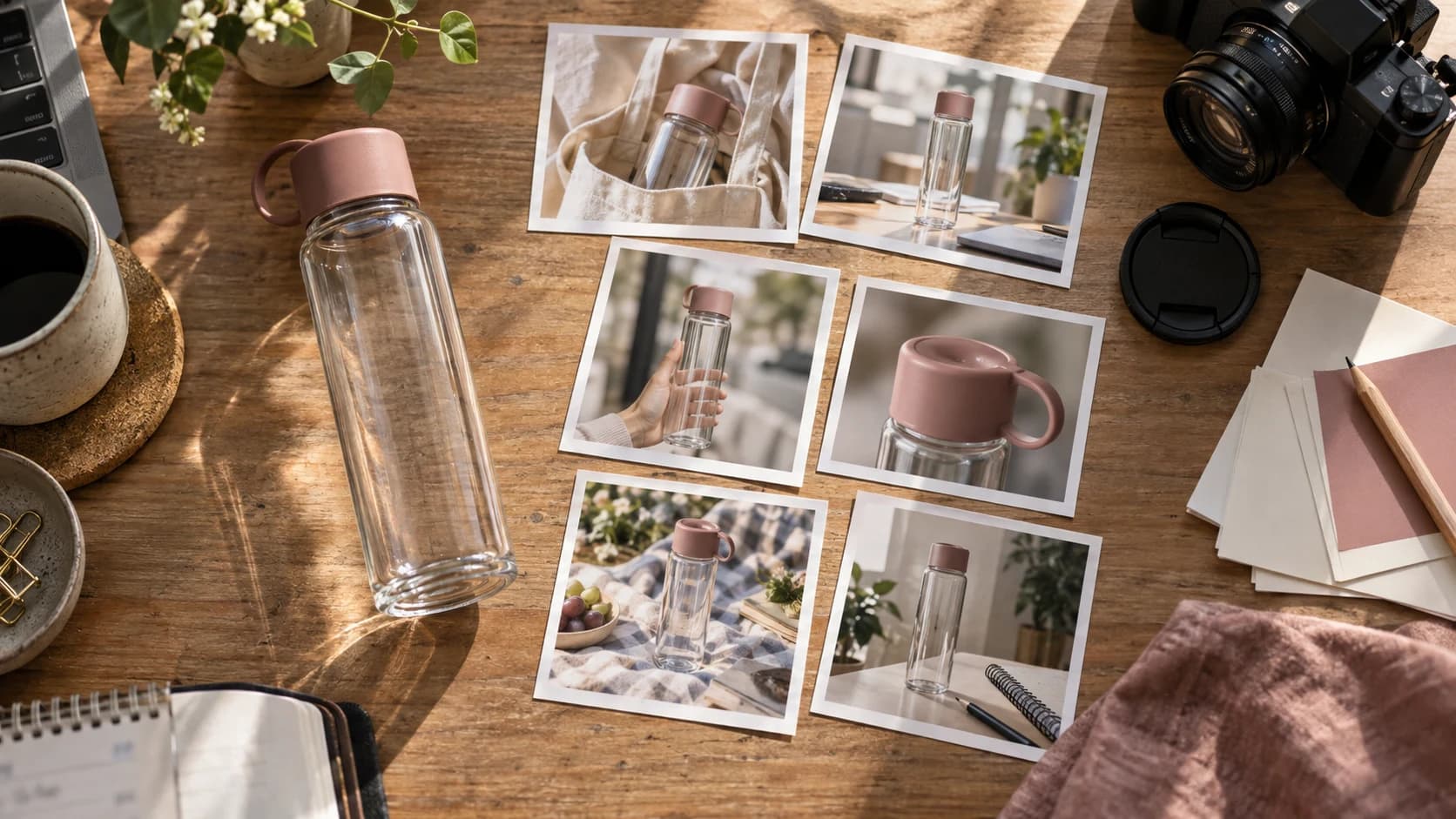
You have photographed the product on a clean background. You have filmed an unboxing. Now the next idea looks suspiciously like the last one. Before adding more props or another transition, try changing the question your content answers.
The six prompts below use a plain ceramic mug as a practice subject. They are creative exercises, not claims about a particular product or predictions of campaign performance.
By the end of this article, you’ll be able to…
- Change the viewer question before changing the visual style.
- Use a familiar object to explore context, process, details, and limitations.
- Choose one angle with evidence you can show and a manageable shot plan.
1. Put it in a specific moment
Question: Where does this belong in someone's day? Show the mug on a small desk while someone prepares to start work. Let the sequence have a beginning, a small action, and an ending. Choose details that explain the moment instead of filling every part of the frame.
Try this opening: “The three things I place on my desk before I begin.” The mug becomes part of a story with a clear setting.
2. Demonstrate one useful action
Question: What can someone understand by seeing this used? Show an ordinary action, such as arranging a drink beside a notebook without blocking the workspace. Keep the demonstration specific to what the footage shows.
Do not turn a simple scene into a claim about durability, safety, or performance that you have not tested. The usefulness can come from the arrangement or routine itself.
3. Notice a detail
Question: What would a viewer miss in a wide shot? Move closer to a texture, shape, or handmade mark. Use a second angle to make the detail easier to understand. If you describe a material or production method, check the actual product information first.
This angle works best when you have something precise to point out. “Look at how the glaze changes near the rim” is a direction for the eye, not a broad claim about quality.
4. Show your own process
Question: How did you create this image? Film yourself moving the backdrop, trying a framing choice, or simplifying the scene. A before-and-after composition can make your creative decision visible.
Keep the process yours to explain. Staging a product photograph is not the same as showing how the product was manufactured.
5. Answer a real question
Question: What has your audience actually asked? Start with a comment, a conversation, or a question you can verify. If you are inventing a question for practice, label it as a prompt instead of presenting it as audience research.
For example, a practice question might be: “How would I photograph a dark mug against a dark desk?” Show your approach and explain its limits.
6. Explain a boundary
Question: What does this example not tell us? An attractive desk scene cannot prove that a cup stays cool, fits every holder, or suits every use. Describe the context honestly and direct viewers to verified product information for specifications.
A useful limitation makes the story more precise. You can say “This is a styling demonstration” and still create an engaging piece.
Choose the angle you can support
Make a three-column note: the viewer question, the evidence you can show, and the shots you need. Select the idea that fits all three. Keep the other prompts for a later project rather than forcing them into the same post.
After making the piece, write down what you would test next. Changing one element—such as the opening or the explanation—can make the next creative decision easier to evaluate. Treat any response you receive as context to learn from, not a guarantee that the same approach will work everywhere.
Cover: an AI-generated editorial image for Unbok. People and scenes are illustrative.